Voltage testers, handheld non-contact detectors, proximity alarms, and personal voltage detectors answer different questions. A voltage tester confirms whether a specific line or piece of equipment is energized at the moment of the test. A proximity alarm warns an equipment operator as a boom approaches a power line. A personal voltage detector warns the worker wearing it as they approach an energized source. Most crews that work near energized lines need more than one.
The Four Tools at a Glance
| Tool | Where it is | The question it answers | When it answers it | What it cannot do |
|---|---|---|---|---|
| Voltage tester | Applied to the line or equipment by a qualified worker | Is this de-energized, right here? | At the moment and place of the test | Tell you about other conductors, or about changes after the test |
| Handheld non-contact voltage detector | In the hand or on a hot stick | Is this spot live? | When the worker points it | Warn about anything it is not pointed at |
| Equipment-mounted proximity alarm | On the crane, derrick, or boom | Is the equipment getting close to a power line? | While the equipment operates | Warn a worker who is away from the equipment |
| Personal voltage detector | On the worker's hard hat | Is this worker moving toward something live? | Continuously, while worn | Verify that anything is de-energized |
Voltage Testers: Verifying the Absence of Voltage
A voltage tester answers the question every grounding and lockout procedure depends on: is this line or equipment de-energized? OSHA 1910.269(n)(5) puts it plainly: "The employer shall ensure that, unless a previously installed ground is present, employees test lines and equipment and verify the absence of nominal voltage before employees install any ground on those lines or that equipment."
A test is a snapshot. It covers the conductor tested, at the time it was tested.
Handheld Non-Contact Voltage Detectors: Spot Checks
A handheld non-contact voltage detector checks for voltage without touching the conductor. The worker points it at a specific spot, often from a hot stick at higher voltages. It is useful for quick checks, and it only checks where it is aimed.
Some wearable devices do both jobs. Compass G2 takes a hot stick adapter for use as a handheld non-contact voltage detector, and Compass Series devices can be operated in handheld mode for low-voltage sources and for tracing wires inside walls with current detection. Emergency features such as impact, fall, and arc flash detection are designed and tested for the hard hat position, and may not work as expected in handheld mode.
Proximity Alarms: Protecting the Equipment's Reach
A proximity alarm is mounted on equipment and warns the operator before the boom, load line, or load gets too close to a power line.
For cranes and derricks in construction, OSHA 1926.1408(b)(4) lists a proximity alarm as one of five measures an employer can choose from when encroachment precautions are required:
- "A proximity alarm set to give the operator sufficient warning to prevent encroachment."
- A dedicated spotter in continuous contact with the operator.
- A device that automatically warns the operator when to stop movement, such as a range control warning device.
- A device that automatically limits range of movement.
- An insulating link or device between the end of the load line and the load.
Three details matter for buyers. Those measures do not apply to work covered by Subpart V, which covers power transmission and distribution. Operators and crew members must be trained on "the limitations of an insulating link/device, proximity alarm, and range control (and similar) device, if used" under 1926.1408(g)(1)(iv). And devices used to comply must meet the manufacturer's procedures for use and conditions of use.
ASTM F3283 is the manufacturing specification for high-voltage proximity alarms. It covers non-contact alarms that detect AC voltage above 600 V on overhead power lines at 50 to 60 Hz, with audible or visual alerts and, on some units, the ability to limit equipment movement. Its scope excludes use, installation, and maintenance. Some wearable devices are tested to it as well: Compass G2 lists ASTM F3283/F3283M-18 among its standards.
Personal Voltage Detectors: A Warning That Moves With the Worker
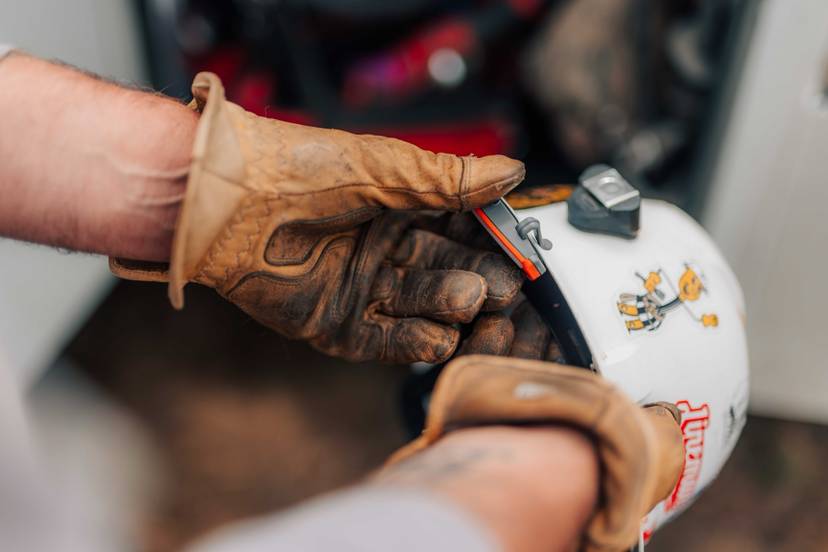
A personal voltage detector is worn, usually on the hard hat brim, and warns the wearer as they approach an energized AC source. It runs the whole time it is worn, so it covers the moments between tests and job briefings, and it goes wherever the worker goes, including away from the truck.
A voltage test is a snapshot. A personal voltage detector runs the whole time it is worn.
Some PVDs also show direction and escalate as the distance closes. Compass directional accuracy is approximately ±20° to a point source, and on the connected Compass models the Max Alert distance is approximately 60% of the First Alert distance.
A PVD is a secondary warning. Detection varies with humidity, shielding materials, walking speed, three-phase field cancellation, and the conductor's surface area, elevation, and nearby grounded objects. An alert means stop and verify. Silence proves nothing. What Is a Personal Voltage Detector? covers how they work in more detail.
Which Tool for Which Job
| Situation | Primary tool | Where a PVD adds value |
|---|---|---|
| Before installing grounds on a line | Voltage test, per 1910.269(n)(5) | A continuous warning while the crew sets up, which does not count as the test |
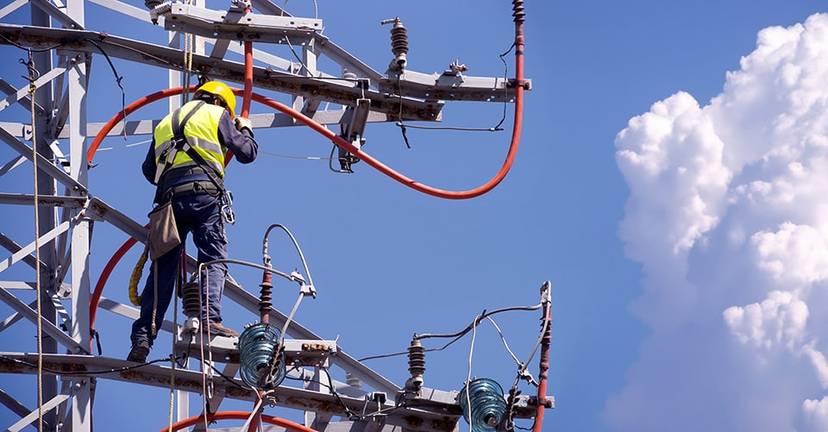
| Operating a crane near power lines in construction | One or more of the 1926.1408(b)(4) measures, such as a proximity alarm | A personal warning for crew members working on the ground near the equipment |
| Checking whether a specific circuit is live | Handheld detector or voltage tester, per your procedure | Warning about nearby sources the worker was not checking |
| Moving through a substation, right-of-way, or storm-damaged area | Job briefing and existing-condition checks | A warning when the worker approaches a source nobody expected |
Frequently Asked Questions
No. A voltage tester verifies the absence of voltage before work such as grounding. A personal voltage detector gives a proximity warning and cannot verify that anything is de-energized.
Not as the only option. For cranes and derricks in construction, 1926.1408(b)(4) requires at least one of five measures when encroachment precautions apply, and a proximity alarm is one of them. Work covered by Subpart V is excluded from that list.
ASTM F3283/F3283M is the standard specification for the manufacturing of high-voltage proximity alarms that detect overhead AC voltage above 600 V at 50 to 60 Hz. It covers how the alarm is built and tested, not how it is installed or used.
Both sense voltage without contact. A handheld non-contact detector checks the spot it is pointed at. A personal voltage detector is worn and warns continuously as the worker moves.
Partly. Compass G2 can be used on a hot stick as a handheld non-contact detector, and Compass Series devices have a handheld mode. None of them replaces a voltage test.
Choosing a Personal Voltage Detector
How to Choose a Personal Voltage Detector covers the nine questions to answer before you buy, from voltage coverage and nuisance alerts to emergency response and hazardous locations.
Sources
- OSHA 29 CFR 1910.269(n)(5), testing before grounding (quoted).
- OSHA 29 CFR 1926.1408, paragraphs (b)(4), (b)(5), and (g)(1)(iv), and the closing note on manufacturer procedures.
- ASTM F3283/F3283M-18(2024), scope sections 1.1 to 1.4.
- Safeguard Equipment: Compass G2 mounting and standards, and the Help Center articles Mount the Device Correctly and Understand Voltage and Current Alerts.