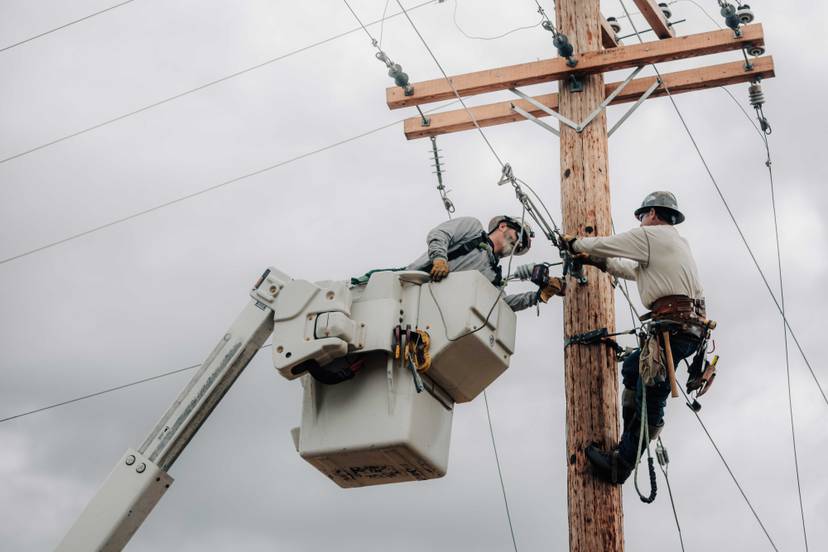
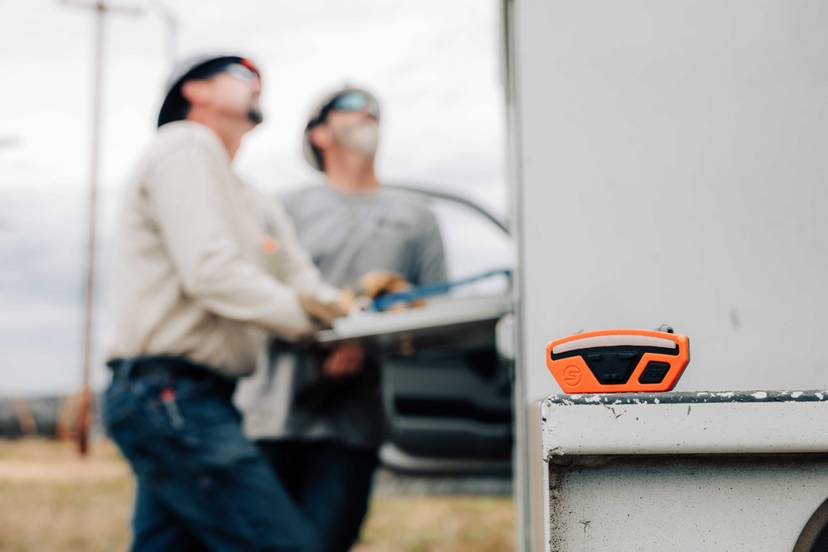
A personal voltage detector (PVD) is a small device, usually worn on the hard hat, that senses the electric field around energized AC equipment and warns the wearer with lights and sound as they get closer. It is a secondary warning. It supplements, and never replaces, testing for voltage, lockout/tagout, minimum approach distances, and PPE.
Why Personal Voltage Detectors Exist
Electrical safety programs depend on knowing which equipment is energized before work starts. OSHA 1910.269(a)(4) requires employers to determine existing conditions before work on or near lines or equipment begins, including nominal voltages and the presence of hazardous induced voltages.
Those checks happen at specific moments. Conditions in the field can change between them: a switching error, a mislabeled circuit, an induced voltage nobody planned for. A PVD adds a warning that runs the whole time the worker wears it, including the moments between checks.
In 2024, 130 U.S. workers died from exposure to electricity on the job, according to the Bureau of Labor Statistics.
How a Personal Voltage Detector Works
An energized AC conductor is surrounded by an electric field, and that field gets stronger closer to the conductor. A PVD measures the field where the worker is and compares it with its sensitivity setting.
- The worker approaches a sourceThe field at the device rises.
- The device crosses its first thresholdIt gives a First Alert, with lights and a tone.
- The worker keeps closing the distanceThe alert grows more urgent and more frequent.
- The device reaches its Max AlertOn the connected Compass models, Max Alert is approximately 60% of the First Alert distance. A First Alert at 10 ft (3.0 m) corresponds to a Max Alert near 6 ft (1.8 m).
Two features separate a basic detector from a more capable one:
- DirectionA directional detector shows which way the source is. Compass directional accuracy is approximately ±20° to a point source.
- Current detectionSome detectors also alert on current, as a separate signal. On Compass devices, red LEDs and a tone mean voltage, and blue LEDs and a tone mean current.
What Changes the Warning Distance
A PVD measures a field, and fields are shaped by their surroundings. The Compass Series User Guide lists the conditions that affect detection:
- Extreme humidity may decrease detection capability.
- Some materials shield electromagnetic fields from the detection circuits.
- Walking briskly may reduce the initial warning distance.
- Three-phase systems can create electric fields that cancel out in certain areas.
- Warning distances vary with the conductor's exposed surface area, its elevation above ground, and its proximity to other grounded conductive objects.
This is why a PVD alert means stop and verify, and the absence of an alert proves nothing.
Never treat a quiet detector as evidence that equipment is de-energized.
Where a PVD Fits in an Electrical Safety Program
A PVD sits alongside the controls a qualified electrical safety program already requires. It does not satisfy any of them.
| Control | What it answers |
|---|---|
| Job briefing and existing conditions | What is energized here, and at what voltage, before work starts? |
| Testing for voltage | Is this line or equipment de-energized, right here, right now? |
| Lockout/tagout and grounding | Will it stay de-energized while we work? |
| Minimum approach distances and PPE | How close can this worker get, and what protects them if something goes wrong? |
| Personal voltage detector | Is the worker moving toward something live that nobody expected? |
For example, OSHA 1910.269(n)(5) requires employees to test lines and equipment and verify the absence of nominal voltage before installing grounds, unless a previously installed ground is present. A PVD is not built to verify the absence of voltage.
Who Uses Personal Voltage Detectors
PVDs are worn wherever crews work near energized infrastructure:
- Utility line crews on distribution and transmission work
- Telecom crews working next to energized power on joint-use poles
- Arborist crews working near energized lines
- Contractors and construction crews on high-risk sites
- Oil and gas and mining crews, where classified areas call for an intrinsically safe model such as Compass Pro IS
How to Use a PVD Correctly
- Mount it where it will be seenCompass Series devices go on the hard hat brim, centered and forward, in the wearer's peripheral vision. Incorrect mounting increases false alarms and creates a false sense of detection coverage.
- Test it before every field useCheck it against a known voltage or current source.
- Keep the firmware currentCompass devices update through Navigator Mobile.
- Treat every alert as a stopIdentify the source and verify before continuing.
- Take faulted devices out of serviceOn Compass devices, red and yellow corner LEDs mean the periodic self-test found a fault and the device needs service.
The Help Center covers both in more detail: Mount the Device Correctly and Device Shows Red and Yellow Fault LEDs.
Frequently Asked Questions
No. A personal voltage detector warns of a field it can detect. Shielding, three-phase cancellation, humidity, and other conditions can reduce detection, so silence is not proof of anything. Use a voltage test to verify the absence of voltage.
Some can. All Compass Series models detect both voltage and current and show them as separate alerts: red for voltage, blue for current.
It depends on the sensitivity setting, the source, and the conditions. Detection distances for Compass devices are documented in the Compass Series User Guide. As a working rule, the Compass Max Alert distance is approximately 60% of the First Alert distance.
They are related. A proximity alarm usually means a device mounted on equipment such as a crane or boom truck, warning the operator. A personal voltage detector is worn by the person.
For Compass Series devices, on the brim of the hard hat, centered and forward. Helmets without a traditional brim need an approved helmet adapter.
Choosing a Personal Voltage Detector
Coverage, alerting, nuisance alarms, emergency response, and hazardous-location approvals all differ between devices. How to Choose a Personal Voltage Detector walks through the nine questions to answer before you buy, and Personal Voltage Detectors vs. Voltage Testers vs. Proximity Alarms covers how a PVD differs from the other tools crews carry.
Sources
- OSHA 29 CFR 1910.269, paragraphs (a)(4), existing characteristics and conditions, and (n)(5), testing before grounding.
- U.S. Bureau of Labor Statistics, Census of Fatal Occupational Injuries, Table A-9, 2024 (published February 2026).
- ASTM F3283/F3283M-18(2024), section 1.4, on detecting the electric field.
- Safeguard Equipment, Compass Series User Guide (September 2026).
- Safeguard Help Center: Understand Voltage and Current Alerts, Mount the Device Correctly, Safety Disclosures and Field Use Warnings, and Device Shows Red and Yellow Fault LEDs.